
High-Temperature Heat Pumps Expanding Across All Application Types
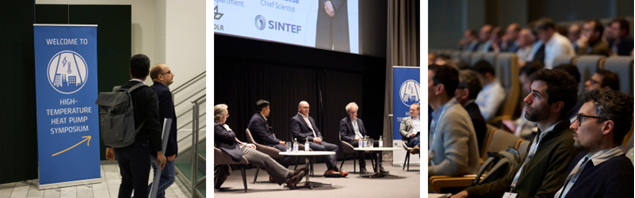
This article is a takeaway from the HTHP Symposium 2026 and explores how high-temperature heat pumps are breaking through the 200 °C barrier, transforming from a promising niche technology into a mature, large-scale solution for heavy industry.
High-temperature heat pumps are undergoing rapid technological development. Temperature limits are rising, and solutions are now emerging for a growing range of industrial applications, as demonstrated at HTHP Symposium 2026.
Temperatures of up to 200 °C are now a reality in some of the latest industrial applications using high-temperature heat pumps. This was evident from the case studies presented at HTHP Symposium 2026 in Copenhagen, where a wide range of suppliers and system integrators showcased both fully commissioned installations and projects currently under development.
In just a few years, high-temperature heat pumps have moved from being a promising niche technology to becoming a credible solution to some of the most demanding heating requirements in industry. Progress is rapid, and new projects show that the technology is increasingly relevant in applications that, only a few years ago, were considered beyond the reach of heat pumps.
Everllence, for example, is working on a solution for Boston’s district heating network, with steam temperatures of up to 180 °C. The system combines a 40 MW ammonia-based high-temperature heat pump with multi-stage steam compression, using energy extracted from the waters of the Charles River. The Boston project shows that the technology is now being considered for very large-scale energy systems and for applications where high-temperature heat pumps must be integrated with existing infrastructure.
Another notable case is at Pelagia’s fishmeal plant in Norway, where a high-temperature solution from Enerin has likewise achieved 200 °C in its drying processes.
- The project at Pelagia has shown that, in addition to delivering major energy savings, we are able to maintain the required protein quality in our fishmeal products - a requirement on which we could not compromise, said Ola Flesland of Pelagia at the symposium.
Enerin also expects to reach 200 °C in its next project, at the pharmaceutical company Roche in Switzerland.
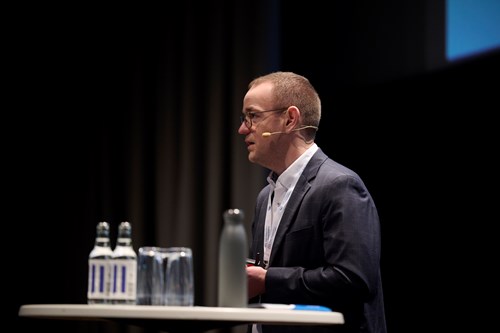
Benjamin Zühlsdorf, Danish Technological Institute.
High temperature with high COP
The overall picture at the symposium was clear: the latest high-temperature applications are achieving ever higher temperatures, and even at these elevated levels it is still possible to deliver a COP that supports an attractive business case.
- High-temperature heat pumps are now being sought for applications that would have been unthinkable just a couple of years ago. We are constantly seeing new projects that are pushing the boundaries of what is technically possible, while also delivering increasingly attractive COPs from a commercial perspective, said Benjamin Zühlsdorf, Innovation Director at Danish Technological Institute.
This development is also reflected in IEA HPT Project 68, which tracks high-temperature heat pump projects worldwide. So far, 56 current high-temperature solutions have been recorded across 14 countries, covering both demonstration projects and fully commercial schemes.
It is precisely this combination of higher temperatures, larger-scale installations, and improved efficiency that is proving crucial. For industry, it is not enough for the technology to work in principle; it must also fit into real production environments, operate reliably at scale, and make economic sense. This is exactly the transition illustrated by many of the new projects.
At the symposium, GIG Karasek presented its upcoming plant at BASF, one of the largest high-temperature projects to date.
- Our solution for BASF is to a large extent based on the fact that the site has substantial volumes of waste heat which can be utilised. At full load, the system delivers a thermal output of 50 MW, giving a COP of 3.3, Josef Grassauer of GIG Karasek told the symposium.
The projected CO2 reduction at BASF is estimated at 100,000 tonnes per year.
Like several of the presented projects, the BASF solution is based on integrating high-temperature heat pumps with Mechanical Vapour Recompression (MVR). MVR technology provides an efficient and reliable way of lifting temperatures, while also enabling pressure and temperature to be increased in stages - helping to achieve an attractive overall COP.
It is projects like these that demonstrate just how quickly the field is advancing and are reshaping perceptions of what high-temperature heat pumps can be used for. As the technology moves into capacities of this scale, it is a clear sign that the market is beginning to mature. The first large-scale installations play a pivotal role: they reduce perceived risk and make it easier for other companies to follow suit.


Josef Grassauer, GIG Karasek, here with Petter Nekså, SINTEF and Jonas Kjær Jensen, DTU.
A wide range of natural refrigerants
The Italian company Turboden has supplied a high-temperature heat pump which recovers waste heat from a steelworks to deliver temperatures of up to 130 °C to the local district heating network in Brescia.
In spring 2026, Turboden commissioned its next major project, involving the integration of a high-temperature heat pump in partnership with the paper manufacturer delfort. The system produces
12 MW of superheated steam at 3.4 bar, lifting the temperature to around 145 °C from low-grade heat sources. A steam compressor is integrated into the system to meet the required pressure levels, enabling full compatibility with the existing process infrastructure.
In this solution, the used refrigerant is a hydrocarbon - isobutane - which has a very low global warming potential (GWP). In addition, the steam itself serves as refrigerant in the vapour compression system.
More broadly, there is a wide range of natural refrigerants which can be used in high-temperature applications. In some cases, natural refrigerants may even offer clear advantages when very high temperatures are required. These include water vapour, hydrocarbons, ammonia, CO2, and helium as alternatives to fluorinated refrigerants.
- Several critical challenges are emerging in the current development of high-temperature heat pumps. One is the design of compressors for processes operating at ever higher temperatures, which places increasing demands on compressor performance when systems are required to run at megawatt scale in commercial production rather than only in the laboratory. Another key area is ensuring that natural refrigerants can be used. Here, hydrocarbons in particular have proved highly suitable for many applications and for high-temperature operation. A third important challenge is system integration, including how to integrate with available process heat sources in order to achieve high temperatures efficiently, said Petter Nekså, Chief Scientist at SINTEF.

Standardisation still to come
Several commercial case studies presented at the symposium involved the integration of high-temperature heat pumps into drying processes. In Belgium, CEE has installed an entirely new high-temperature system for brick drying, with a capacity of 160,000 bricks per day. The plant delivers 3.4 MW of hot water at 120 °C with a COP of 4.5. Much of the benefit has been achieved by recovering waste heat at 150 °C to 250 °C from kilns operating at 1,000 °C.
- An energy saving of 25 per cent has been achieved, and the drying time for the bricks has been reduced from 60 to 40 hours. We hope that it may be possible to reduce this further to 30 hours by using even higher temperatures, said Maarten de Winter, Project Manager at CEE.
In another commercial project, CEE has supplied a high-temperature solution for the production of 2.4 tonnes of fire-retardant boards per hour. Here, a COP of 3.7 has been achieved at temperatures of 120 °C.
For more rapid market uptake, HTHP solutions need to be viable both for new-build installations (greenfield projects) and as tailored retrofit solutions for existing facilities (brownfield projects). Both types of solution were presented at the symposium, and experience shows that when a high-temperature heat pump is integrated into an existing industrial process, the investment in the heat pump itself may account for only around 20 per cent of the total project cost, while integration makes up the greater share. This is linked to the fact that large-scale standardisation has yet to materialise.
- We are still seeing many bespoke solutions, and that drives up integration and installation costs. Standardisation is a sign of technological maturity and is essential, not least if we are to reduce CAPEX in high-temperature projects, said Dave Jones, Chief Analyst at Ember.
So, although progress is rapid, barriers still remain. Standardisation is, therefore, a crucial next step. The conclusion at the symposium was that if the industry can develop more standardised solutions and integration concepts, costs can be reduced, projects can be delivered more quickly, and the technology can achieve wider adoption.
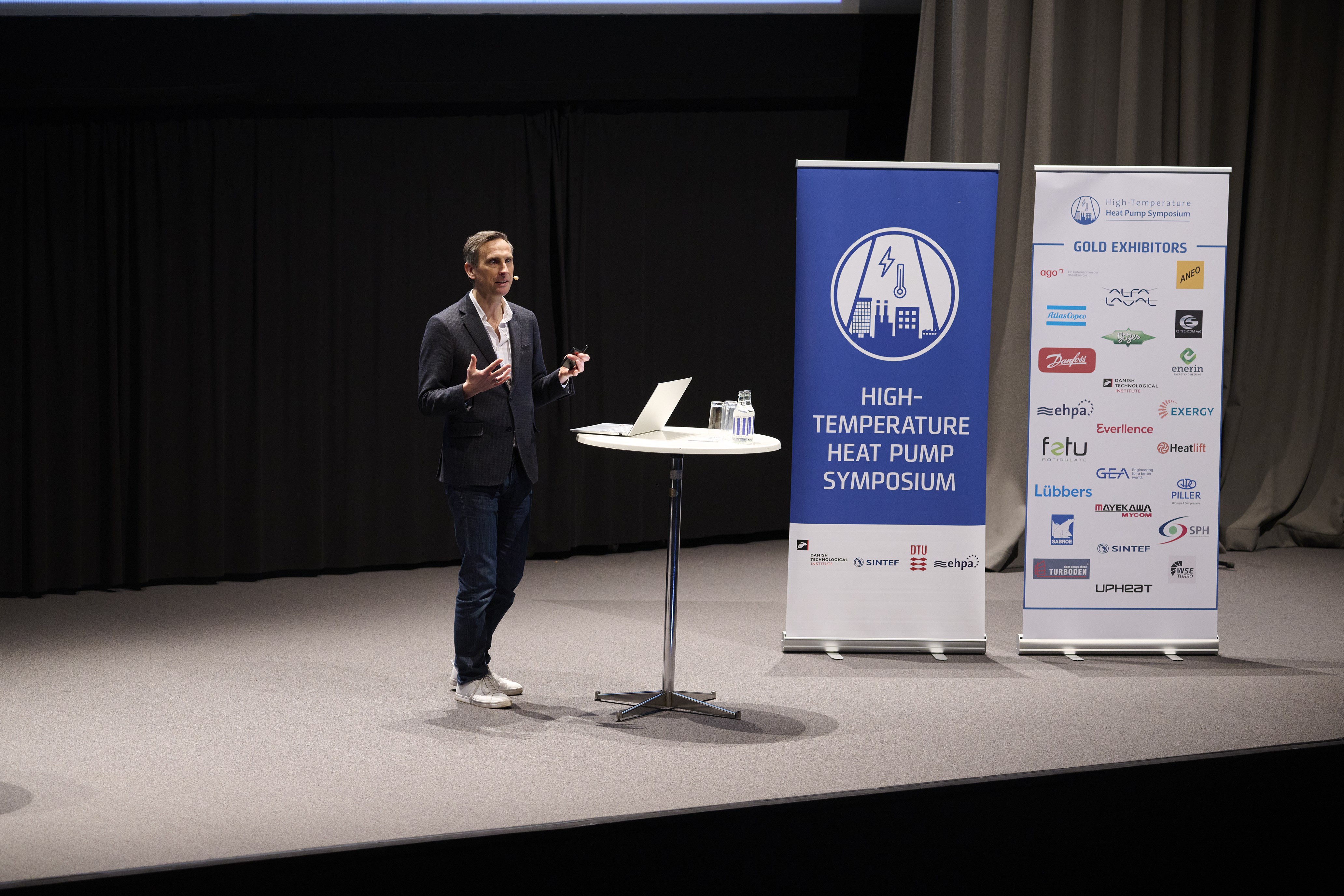
Dave Jones, Ember.
_________________________________________________________________________________________
HTHP Symposium 2026
- 530 participants
- 37 exhibitors
- 78 presentations
- 45 poster presentations
- 3 sector workshops
_________________________________________________________________________________________